
Formulation Guides
Peptide Serum Formulation in 2026: How to Stack Cosmetic Peptides Without Guessing
Sep
Peptide Serum Formulation in 2026: How to Stack Cosmetic Peptides Without Guessing
Peptides continue to be a major skincare ingredient story in 2026, with beauty-industry coverage highlighting signal peptides, copper peptides and other targeted sequences. For formulators, however, the useful question is not “How many peptides can I put on the label?” It is how to build a stable, documented multi-peptide system in which every raw material has a clear role.
Start with peptide function, not peptide count
A strong formula begins with a product brief. Decide whether the product is primarily about skin feel, hydration, the appearance of firmness, expression-line-focused cosmetic positioning, eye-area care or another cosmetic objective. Then select ingredients that support that brief instead of stacking actives simply because they are popular.
Why two peptide solutions with similar names may formulate differently
The INCI name does not tell you the full composition of a commercial raw material. A peptide may be sold as a powder, a diluted aqueous solution or a multi-component blend with solvents and preservatives. That changes the amount of actual peptide delivered when the raw material is added to a formula.
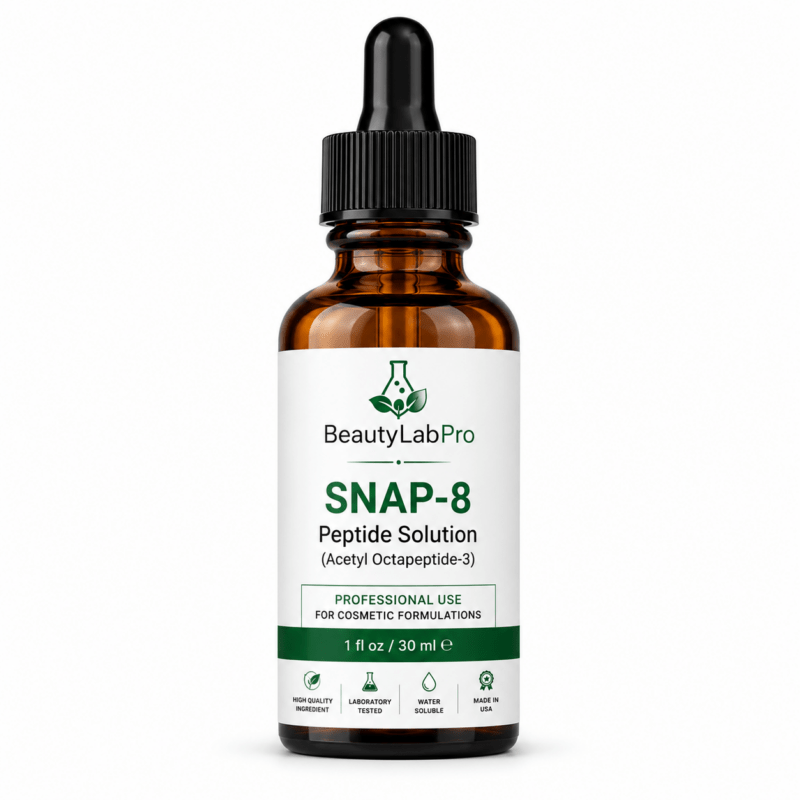
BeautyLabPro’s live peptide catalog includes Argireline Peptide Solution, SNAP-8 Peptide Solution and Copper Peptide (GHK) Peptide Solution. Each should be formulated according to the documentation for its exact grade and batch.
A safer workflow for combining cosmetic peptides
1. Build an ingredient map
List the exact trade/raw-material name, INCI, carrier, supplied concentration where documented, preservative system and supplier-recommended processing conditions for every peptide ingredient.
2. Find the overlap in processing windows
Do not invent a universal peptide pH or temperature. Compare the TDS for each exact grade and design the formula around the compatible overlap. If the documents conflict, reformulate or ask the supplier rather than guessing.
3. Calculate active contribution correctly
A 5% addition of a diluted peptide solution is not necessarily 5% pure peptide. Claims and cost calculations should distinguish the supplied raw material from its active peptide content where that information is available.
4. Add preservation and stability to the plan
Multi-active water-based serums still require a suitable preservation system. Test pH, viscosity, color, odor and package compatibility over time and use appropriate microbial and stability testing for the intended market.
Common multi-peptide formulation mistakes
Percentage inflation: treating the addition rate of a diluted raw material as the pure-active percentage.
Generic compatibility rules: assuming every peptide behaves identically because the label says “peptide.”
Ignoring the carrier: forgetting that glycerin, glycols, water, salts and preservatives delivered with a raw material become part of the final formula.
Skipping documentation: using a blog recipe instead of the batch COA/TDS when exact processing information is required.
What should a professional peptide formula record include?
Keep the supplier and lot number, COA, TDS/SDS where applicable, formula version, weighed quantities, manufacturing order, temperatures, pH adjustments, finished pH, appearance, viscosity observations and stability results. This creates a reproducible product-development record rather than a one-off kitchen recipe.
Explore peptide ingredients
Browse the BeautyLabPro Peptides collection for professional cosmetic ingredients. Free standard U.S. shipping is available on qualifying orders of $69+.
For a broader 2026 framework, read our new skin longevity formulation guide, which connects peptide selection with hydration and formula architecture.
For cosmetic formulation use only. Exact use level, pH, solubility and processing conditions should follow the technical documentation for the specific grade and batch.