
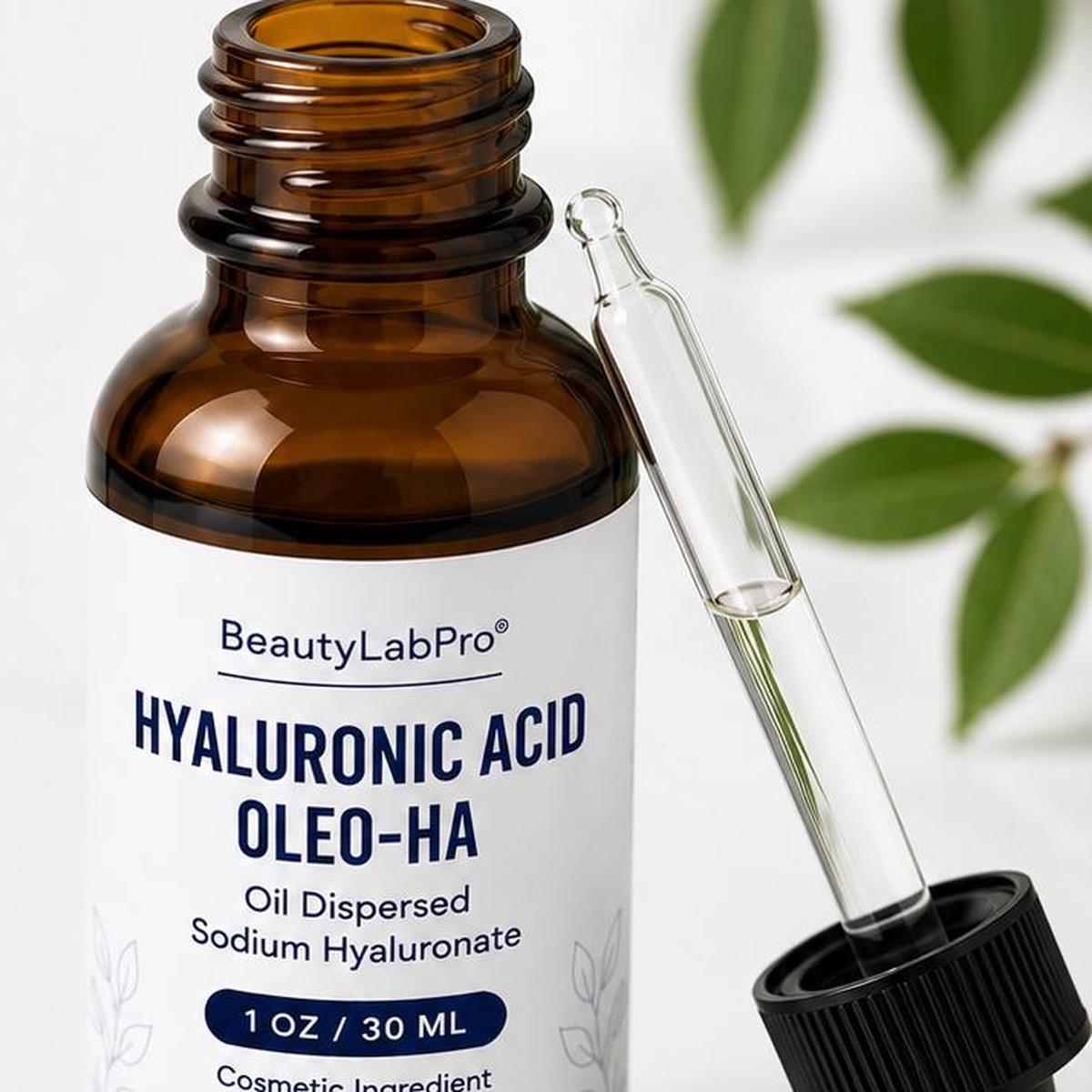
Oleo-HA Oil-Dispersed Hyaluronic Acid brings sodium hyaluronate into water-free products: lip balms, glosses, lip oils, lipsticks, foundations and BB creams where ordinary water-soluble HA simply will not mix. Developed for the color cosmetics industry, it is offered in four sizes, 0.33 fl oz (10 ml), 1 fl oz, 4 fl oz and 16 fl oz.
What Oleo-HA Is
Standard hyaluronic acid needs water to dissolve, so it cannot be stirred into a stick or an anhydrous foundation. Here, small-molecule HA (under 10,000 daltons) is spread evenly through an oil phase using microsphere technology. When the product meets the skin, the HA is released while the oil leaves a soft film on the surface.
Properties
Oil-dispersible paste
An ivory white to yellowish ointment with a light castor oil odor. It disperses in oil rather than fully dissolving.
Melting point 72 C (162 F)
This figure tells you when to add it: after the hot steps, once the batch has cooled below it.
Hydration without water
Lip and makeup products with no water phase can carry a hydrating ingredient for a smoother, softer feel on dry-feeling lips.
Applications
Lip balms, glosses, oils and lipsticks are the main use, where Oleo-HA supports the look of fuller, plumper-looking lips. Oil-based foundations and BB creams are a second group, and water-free balms and facial oils a third, often built on a light carrier such as Jojoba Oil; oil-soluble actives such as Matrixyl 3000-Type Lipo Concentrate can share the same oil phase. For gels and serums with water, the matching choice is our Hyaluronic Acid Gel. Both sit in the hyaluronic acid category.
How to Use
The supplier recommends 0.1 to 2%. Complete all heating, homogenizing and emulsifying first, let the batch cool below 72 C, then add Oleo-HA and stir thoroughly. Because it is a dispersion, it may settle in very light oils; bases thickened with waxes or butters hold it more evenly. For more detail, read our guide Glycerin vs Hyaluronic Acid: Which Humectant to Choose.
Compatibility
Oleo-HA belongs in anhydrous and oil-based systems. In a water-based serum, use water-soluble HA instead. If settling appears in a thin oil, add a little wax or a heavier oil to the base.
Picking a size
The 10 ml bottle is a sample or small-batch size, 1 fl oz is the starter size for makers, 4 fl oz suits medium production and 16 fl oz serves larger batches and small businesses.
Why not just add water-soluble HA?
Without a water phase it cannot dissolve, and adding water would mean an emulsifier and a different product. Oleo-HA skips that step entirely.
Characteristics
INCI: Sodium Hyaluronate, Hydrogenated Castor Oil, Ricinus Communis (Castor) Seed Oil. Appearance: ivory white to yellowish ointment or paste. Odor: light castor oil. Solubility: oil-dispersible. Melting point: 72 C (162 F). HA molecular size: under 10,000 daltons.
Recipe: Hydrating Lip Oil (10 g)
Ingredients: 9.8 g jojoba oil and 0.2 g Oleo-HA. Warm the jojoba, let it cool below 72 C, then stir in the Oleo-HA until uniform. Fill into a clean wand or roller bottle. If you see settling, replace a little of the jojoba with a thicker oil or a touch of wax. Patch test the finished product.
Storage
Supplied in airtight containers; keep tightly closed in a cool, dry place away from light.
Order the 10 ml size and give your lip line a hydrating upgrade.
FAQ
Can I use Oleo-HA in a water-based serum?
No, it is built for anhydrous and oil-based products; use water-soluble HA in serums.
Why does it settle in my oil?
It disperses rather than dissolves, so very light oils let it sink; a thicker base holds it.
At what point do I add it?
After heating and mixing, once the batch is below 72 C (162 F).
What is the recommended level?
0.1 to 2%, according to the supplier.
| Size | 0.33 fl oz (10 ml), 1 fl oz, 4 fl oz, 16 fl oz |
|---|
Reviews
There are no reviews yet.