Product Development Guides
Hexapeptide-9 Peptide Powder: Guide, Compatibility and Common Mistakes
Sep
Hexapeptide-9 is drawing interest from product developers who want concentrated peptide raw materials rather than another pre-diluted finished-serum concept. The practical challenge is not simply adding a trendy peptide to a formula; it is understanding the exact supplied grade, building an appropriate carrier system, and validating the finished product.
Short answer: Hexapeptide-9 powder is an INCI-designated cosmetic peptide for skin-conditioning and appearance-focused products. As a powder, it gives you control over the carrier system and the final concentration. Validate dissolution, processing temperature and pH in the complete recipe.
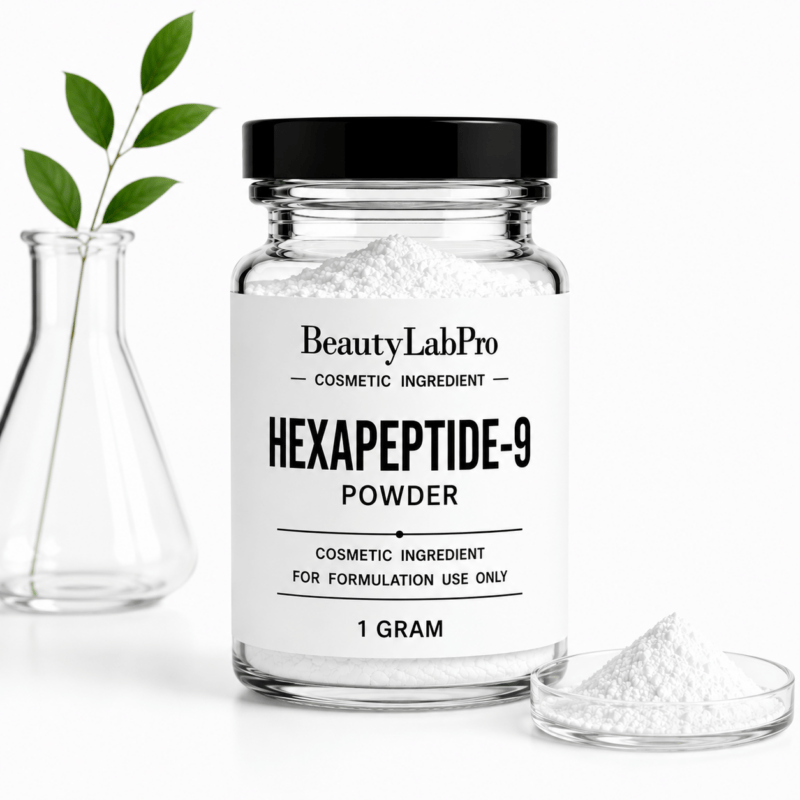
This guide covers the product decisions that matter most when working with BeautyLabPro Hexapeptide-9 Peptide Powder. It is a professional cosmetic raw material, not a ready-to-apply skincare serum.
What is Hexapeptide-9 in cosmetic products?
Hexapeptide-9 is an INCI-designated cosmetic peptide used in skin-conditioning and appearance-focused formulas. A powder format gives the product developer direct control over the carrier and final concentration, but that flexibility also means the processing method must be designed for the exact grade being used.
Identity, assay, exact solubility, pH guidance, storage, processing temperature and recommended use level can depend on the supplier and batch. Use the verified TDS/COA for the exact lot rather than copying numbers from another seller or from a pre-diluted peptide solution.
Why product developers choose peptide powder
Control over the carrier system
A powder lets the developer choose the vehicle that best fits the finished product instead of inheriting the carrier from a commercial solution. This can be useful when developing a custom serum, gel, cream or multi-peptide system.
Control over the finished concentration
With concentrated raw material, the product developer can calculate the amount needed for the intended batch rather than being limited to the concentration of a pre-diluted solution. That does not mean a higher concentration is automatically better; the appropriate use level should come from the exact technical documentation and the finished-product brief.
How to approach dissolution and incorporation
Do not begin with a generic internet recipe. First confirm the exact solubility and processing instructions for the supplied Hexapeptide-9 grade. Then prepare a small bench batch and observe whether the ingredient fully incorporates into the selected system.
If the formula is aqueous, consider the complete water phase, humectants, electrolytes, rheology modifiers and preservation system. If the peptide is being combined with other actives, add them in a controlled sequence so any loss of clarity, viscosity shift or precipitation can be traced.
Processing temperature matters
Peptides are not a category where one universal heat rule should be invented. Use the temperature guidance from the exact supplier TDS and avoid borrowing processing instructions from another peptide simply because both are powders.
pH should be validated in the complete formula
The pH of a finished serum or gel is determined by the whole system. Check the range supported by the exact peptide grade, then measure and monitor the finished formula during stability work rather than assuming the initial pH will remain unchanged.
Can Hexapeptide-9 be combined with other peptides?
Multi-peptide formulas are common, but compatibility must be demonstrated in the actual base. BeautyLabPro also offers Acetyl Hexapeptide-8 Powder and SNAP-8 Type / Acetyl Octapeptide-3 Powder for product developers developing more complex peptide systems.
Before combining them, compare each ingredient’s supplied form, carrier requirements and batch documentation. Then validate physical stability, pH, appearance, odor, viscosity and preservation where applicable. A list of individually compatible ingredients does not guarantee that the complete formula will be stable.
Common Hexapeptide-9 mistakes
1. Handling powder and solution specifications as interchangeable
A concentrated powder and a pre-diluted solution are different product inputs. Their use levels and processing instructions should not be copied between formats.
2. Adding the peptide before the base is stable
Establish a reliable base first. This makes troubleshooting much easier and keeps the peptide from being blamed for a viscosity or preservation problem caused elsewhere in the system.
3. Scaling before completing bench stability work
A formula that looks clear after mixing is not automatically production-ready. Observe the complete system over time and under the stability conditions appropriate for your development process.
4. Handling a raw ingredient as consumer-ready skincare
Hexapeptide-9 powder is supplied as a raw material for cosmetic products. It requires a properly designed finished formula, appropriate preservation where needed, safety assessment and regulatory review.
Where Hexapeptide-9 fits in a peptide development program
Shop Hexapeptide-9 Peptide Powder — 1 g for your first bench batch, and browse the Peptide Powders collection for other concentrated actives. If a pre-diluted format is more appropriate for your workflow, compare the BeautyLabPro Peptides collection.
Commercial CTA: Shop BeautyLabPro professional cosmetic ingredients for product development.
Related guides: Acetyl Tetrapeptide-5 vs Acetyl Hexapeptide-8 for Eye-Area Products and Pentapeptide-18 Peptide Powder: Reconstitution, Compatibility and Mistakes.
FAQ
What is Hexapeptide-9?
Hexapeptide-9 is an INCI-designated cosmetic peptide used in skin-conditioning and appearance-focused formulas. A powder format gives the product developer direct control over the carrier and final concentration, but that flexibility also means the processing method must be designed for the exact grade being used.
Why choose Hexapeptide-9 as a powder?
A powder lets the developer choose the vehicle that best fits the finished product instead of inheriting the carrier from a commercial solution. This can be useful when developing a custom serum, gel, cream or multi-peptide system. With concentrated raw material, the product developer can calculate the amount needed for the intended batch rather than being limited to the concentration of a pre-diluted solution.
Can Hexapeptide-9 be combined with other peptides?
Multi-peptide formulas are common, but compatibility must be demonstrated in the actual base. BeautyLabPro also offers Acetyl Hexapeptide-8 Powder and SNAP-8 Type / Acetyl Octapeptide-3 Powder for product developers developing more complex peptide systems. Before combining them, compare each ingredient’s supplied form, carrier requirements and batch documentation.
Does processing temperature matter for Hexapeptide-9?
Peptides are not a category where one universal heat rule should be invented. Use the temperature guidance from the exact supplier TDS and avoid borrowing processing instructions from another peptide simply because both are powders.