
Formulation Guides
Palmitoyl Tripeptide-5 Powder in Serums vs Creams: Reconstitution, Phase Choice and Compatibility
Sep
Peptide formulation in 2026 is increasingly about delivery and system design, not simply adding another peptide name to an ingredient list. For formulators working with a concentrated peptide powder, the practical questions are: how should the raw material be introduced, which phase should carry it, and how do you prevent a promising bench concept from becoming an unstable finished formula?
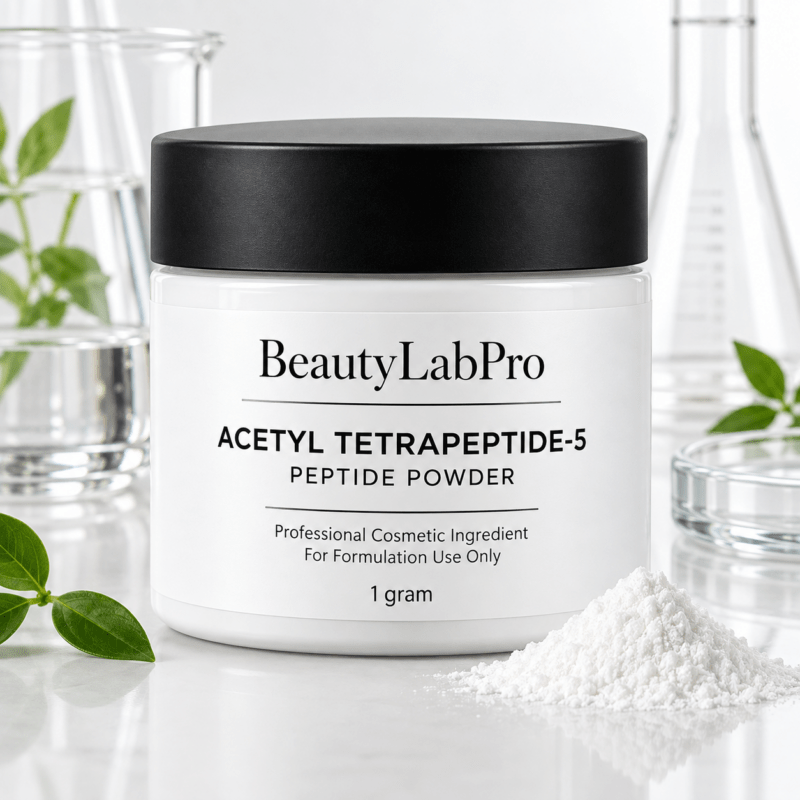
This guide focuses on BeautyLabPro Palmitoyl Tripeptide-5 Peptide Powder. It is a concentrated cosmetic raw ingredient for formulation use, not a finished serum or cream.
Why powder format changes the formulation workflow
A pre-diluted peptide solution arrives with an existing carrier system. A powder gives the formulator more control, but also more responsibility. You must confirm identity, assay, solubility, stock-solution approach, processing conditions and the final level from the documentation for the exact supplied lot.
Do not assume that instructions for another Palmitoyl Tripeptide-5 grade, a branded peptide complex or a liquid commercial blend automatically apply to this powder.
Serum or cream: start with the finished system
Water-based serum
A serum can be an efficient format when the exact peptide grade can be incorporated into the intended aqueous carrier system. Before building the complete formula, screen the raw material or prepared stock solution for clarity, precipitation, color change and compatibility with the base.
Once other ingredients are added, re-check the system. Humectants, polymers, salts, botanical extracts and other actives can change solubility or viscosity even when each component looks stable on its own.
Emulsion or cream
In an emulsion, a water-compatible peptide is generally handled through the appropriate aqueous or post-emulsification route rather than treated like an oil-phase ingredient. But the exact point of addition and maximum processing temperature depend on the grade and batch documentation. Do not copy a universal cool-down temperature from another peptide.
The emulsion itself also has to tolerate the peptide stock solution. Adding water, solvent, electrolyte or other carrier material can shift viscosity or emulsion stability.
Reconstitution: the step most likely to create avoidable problems
Reconstitution should be designed from the exact TDS/COA or supplier specification for the lot. The correct solvent or carrier, concentration of the stock, mixing method, temperature and storage window can vary by grade.
What to document during a stock-solution trial
- Exact mass of peptide powder and carrier.
- Carrier identity and grade.
- Mixing order and mixing time.
- Temperature during preparation.
- Appearance immediately after preparation.
- Appearance after standing under the intended storage condition.
- Any change in clarity, particles, color or odor.
A clear stock solution at minute one is not proof of long-term compatibility.
Compatibility checks for Palmitoyl Tripeptide-5 formulas
pH
Do not invent a universal pH window. Set the finished formula only after reviewing the exact technical documentation for the peptide and the requirements of every other pH-sensitive ingredient in the system.
Temperature
Peptides can be sensitive to processing conditions, but the acceptable temperature depends on the supplied grade. Follow the exact batch TDS rather than assuming that every peptide must be added at the same temperature.
Electrolytes and polymers
Changes in ionic load can affect some rheology modifiers and gel networks. If a peptide stock changes viscosity, do not immediately increase polymer. First determine whether the carrier, pH or ionic contribution is responsible.
Other peptides and multi-active systems
Peptide stacking is possible only when the components are mutually compatible in the actual finished formula. Build combinations deliberately, one addition at a time. BeautyLabPro’s peptide serum formulation guide covers a practical approach to combining multiple cosmetic peptides without relying on guesswork.
Serum vs cream: which format is better?
Neither is universally better. Choose based on the product brief and the behavior of the exact raw materials.
Choose a serum when
- You want a lightweight leave-on format.
- The peptide and other actives are compatible with the intended water-based system.
- The rheology remains stable after the peptide stock is added.
- The packaging protects the formula appropriately.
Choose a cream when
- You need a richer sensorial profile or a broader emollient system.
- The emulsion remains stable after the peptide-containing phase is introduced.
- The processing sequence can respect the peptide grade’s documented requirements.
- The final preservation and packaging system has been validated.
Common Palmitoyl Tripeptide-5 powder mistakes
- Treating powder like a finished serum. It is a concentrated raw material that must be formulated.
- Using another supplier’s universal percentage. Use level and assay can be grade-specific.
- Skipping the stock-solution test. Reconstitution behavior should be observed before a full batch is built.
- Ignoring carrier contribution. The stock solution can change pH, viscosity or preservation requirements.
- Adding several peptides simultaneously in the first prototype. That makes troubleshooting much harder.
- Assuming visible stability equals validated stability. Finished products require appropriate stability, preservation, compatibility and safety testing.
A disciplined development sequence
- Review the exact BeautyLabPro lot TDS/COA and specification.
- Choose the finished format and target sensory profile.
- Prepare a small peptide stock trial according to the exact documentation.
- Introduce it into a simple base and observe the system.
- Add other actives one at a time.
- Check pH, appearance and viscosity where relevant.
- Evaluate preservation and packaging compatibility.
- Run the appropriate stability and safety program before scale-up.
Shop Palmitoyl Tripeptide-5 Peptide Powder
BeautyLabPro supplies Palmitoyl Tripeptide-5 Peptide Powder for professional cosmetic formulation. For broader format comparisons, browse the BeautyLabPro Peptide Powders collection.
Build peptide formulas from documented raw materials, not generic percentages. Free standard U.S. shipping on qualifying orders $69+ from BeautyLabPro.